2026 Functional Verification Study: Executive Findings
Get an overview of the current industry baseline, participant profile, six headline findings, and their principal implications for functional verification.
-
Executive Summary
The 2026 Siemens EDA and Wilson Research Group Functional Verification Study describes an industry in which processor-rich and accelerator-class designs, software-driven behavior, safety and security requirements, and increasingly complex system interactions are reshaping functional verification. Across 604 qualified participants, first-silicon success continues to decline, FPGA production bug escapes have risen, verification consumes roughly half of project time, and most projects are behind schedule. These outcomes should not be read as independent causal claims. Their significance lies in the way multiple related signals move together: processor-rich designs are nearly universal, accelerator-class participation is high, verification environments are broadening, and firmware-, safety-, and security-related issues are more visible. Taken together, the pattern suggests that risk increasingly arises from interactions among hardware, software, architecture, workloads, clocking and reset, power, safety, security, and system operation—not only from isolated design errors. Established RTL methods remain essential, but teams must now build confidence in complete executable systems. his report establishes the current 2026 baseline and summarizes six headline findings; companion publications provide methodology guidance, deeper connected-trend interpretation, focused AI and DFT analysis, and complete supporting data.1–4
Introduction
The 2026 study establishes the current baseline
The 2026 Siemens EDA and Wilson Research Group Functional Verification Study includes 604 qualified participants: 320 working on IC/ASIC projects and 284 working on FPGA projects. Participants represent a broad range of regions, job functions, and design segments, with particularly strong participation from CPU, GPU, and AI accelerator-class projects. This concentration is consistent with published evidence of rapid growth in AI-driven computing, GPUs, and custom accelerators, although the external sources do not validate the study’s exact
participant mix.5–8The 2026 study uses the same qualified recruitment approach introduced in 2024 and achieved a high level of response completeness. It therefore provides the clearest basis for comparison with the 2024 results. The companion methodology paper explains the recruitment change and how it affects comparisons with studies conducted before 2024.2
The results show that functional verification is expanding beyond traditional RTL closure.11 Processor-rich designs, advanced integration, clocking and reset behavior, safety and security requirements, DFT, cloud computing, and AI-assisted workflows increasingly intersect. Project outcomes have also worsened: first-silicon success continues to decline, FPGA production bug escapes have risen, verification consumes roughly half of project time, and most projects are
behind schedule.No single survey result identifies the cause of these changes. The strongest conclusion comes from convergence across outcomes, design context, methods, and reported failure contributors. This executive overview presents the current baseline and six headline findings, summarizes the study’s key limitations, and directs readers to the Data Atlas, methodology reference, Five
Signals, and focused technical papers for deeper analysis.1–4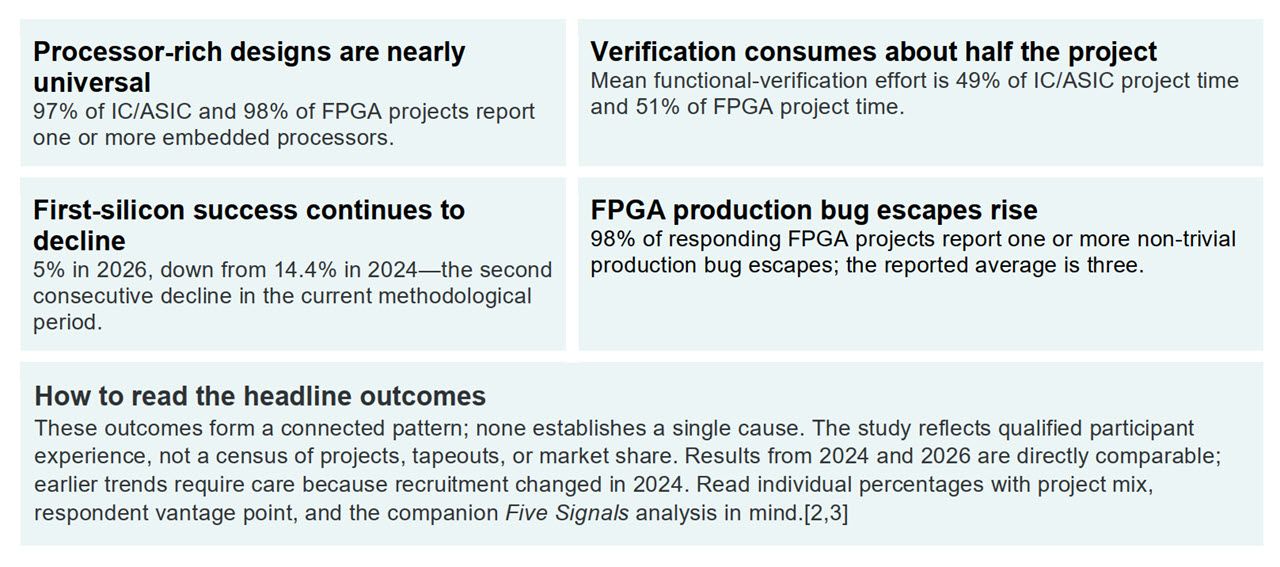
-
Download White Paper
-
2026 Functional Verification Study: Executive Findings
This paper reveals an industry in which processor-rich and accelerator-class designs, software-driven behavior, safety and security requirements, and increasingly complex system interactions are reshaping functional verification. First-silicon success continues to decline, FPGA production bug escapes have risen, verification consumes roughly half of project time, and most projects are behind schedule.
-
-
Related Session
-
2026 Functional Verification Study: Executive Findings
This video explores the key findings from the 2026 Functional Verification Study: Executive Findings white paper, which depicts an industry where processor-rich and accelerator-class designs, software-driven functionality, safety and security requirements, and increasingly complex system interactions are reshaping the nature of functional verification.
-
-
Related White Papers
-
Five Signals from the 2026 Functional Verification Study
Explore five connected trends shaping functional verification, including alternative explanations, interpretation guardrails, respondent-vantage considerations, and the industry’s shift toward building system confidence in executable systems.
-

AI in Functional Verification: What the 2026 Industry Data Reveals
Learn where AI is being applied within functional verification, how broadly it is integrated into engineering workflows, and where adoption remains limited.
-
DFT's Expanding Role in Software-Driven Silicon: From Structural Test Closure to System-Assurance Evidence
Examine the earlier verification of design-for-test logic, integration between DFT and functional verification, accelerated execution, and evolving ownership across engineering teams.
-
-
Related References
-

Functional Verification Study Survey Methodology Evolution
Interpreting Long-term Results Across the 2024 Methodology Transition
Understand the study’s recruitment transition, the appropriate use of historical comparisons, the treatment of nonresponse, and important considerations for interpreting the survey results.
-
2026 Functional Verification Data Atlas
Access the complete study data, including charts, survey-question wording, response bases, IC/ASIC and FPGA breakouts, nonresponse information, and data-quality notes.
-
-
Verification Horizons Blog
-

The 2026 Functional Verification Study: Evidence of a New Verification Operating State
We have released the results of the 2026 Siemens EDA and Wilson Research Group Functional Verification Study.In previous years, we published separate IC/ASIC and FPGA reports. For 2026, we expanded that approach into a broader research collection: four focused whitepapers, a methodology reference paper, and a Functional Verification Data Atlas containing the supporting findings and historical trends.There is a lot of data in this year’s study. But one result is difficult to ignore.
-