Hi there,
what’s the best way to write assertions for following:
once seq_a is triggered, before seq_c triggered, seq_b should not happen. suppose seq_a, seq_b, and seq_c are all defined already.
Thanks,
Jeff
Hi there,
what’s the best way to write assertions for following:
once seq_a is triggered, before seq_c triggered, seq_b should not happen. suppose seq_a, seq_b, and seq_c are all defined already.
Thanks,
Jeff
In reply to Jeff_Li_90:
I see 3 possible interpretations of this requirement:
// once seq_a is triggered, before seq_c triggered, seq_b should not happen.
// If seq_a starts and completes, then
//    * that same start time (e.g., the $rose(a))
//      the completion seq_b (i.e., its endpoint) followed by seq_c should not occur
/* seq_a                    |======>
seq_b                       <=====> // ERROR: seq_b before seq_c
seq_b.triggered      ^   |........^
seq_c                              <======>    */
    // If seq_a starts and completes, then
//    * that same start time (e.g., the $rose(a))
//      the completion seq_b (i.e., its endpoint)
//           should not be inside the completon of seq_c
//      Note: seq_b and seq_c can start at any time
/* seq_a                    |======>
seq_b                       <=====> // ERROR: seq_b before seq_c
seq_b.triggered      ^   |........^
seq_c                          <======>
seq_c.triggered          |............^            */
Below is my code.
I see interpretation 2 as the best intent.
Code also at http://systemverilog.us/vf/seqinnoseq.sv
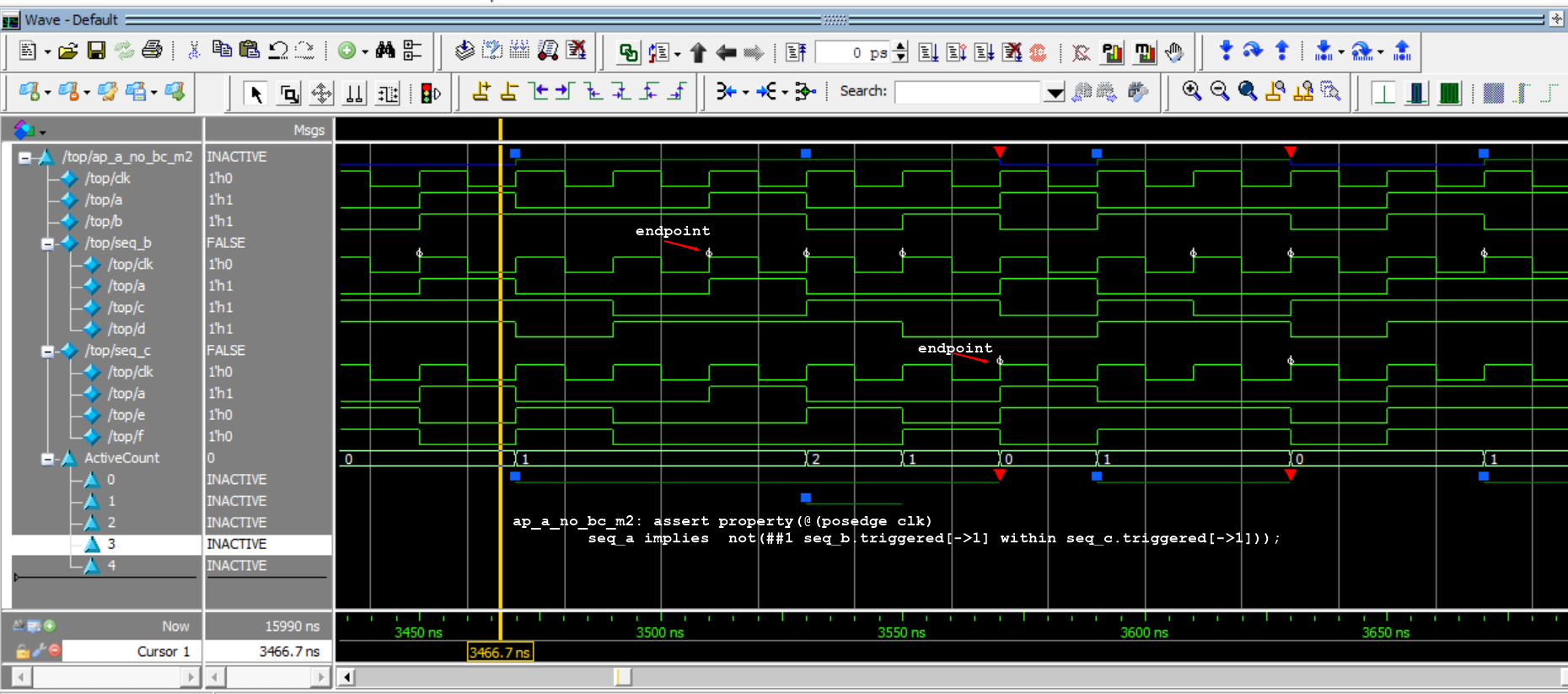
Wave http://systemverilog.us/vf/m2_wave.png
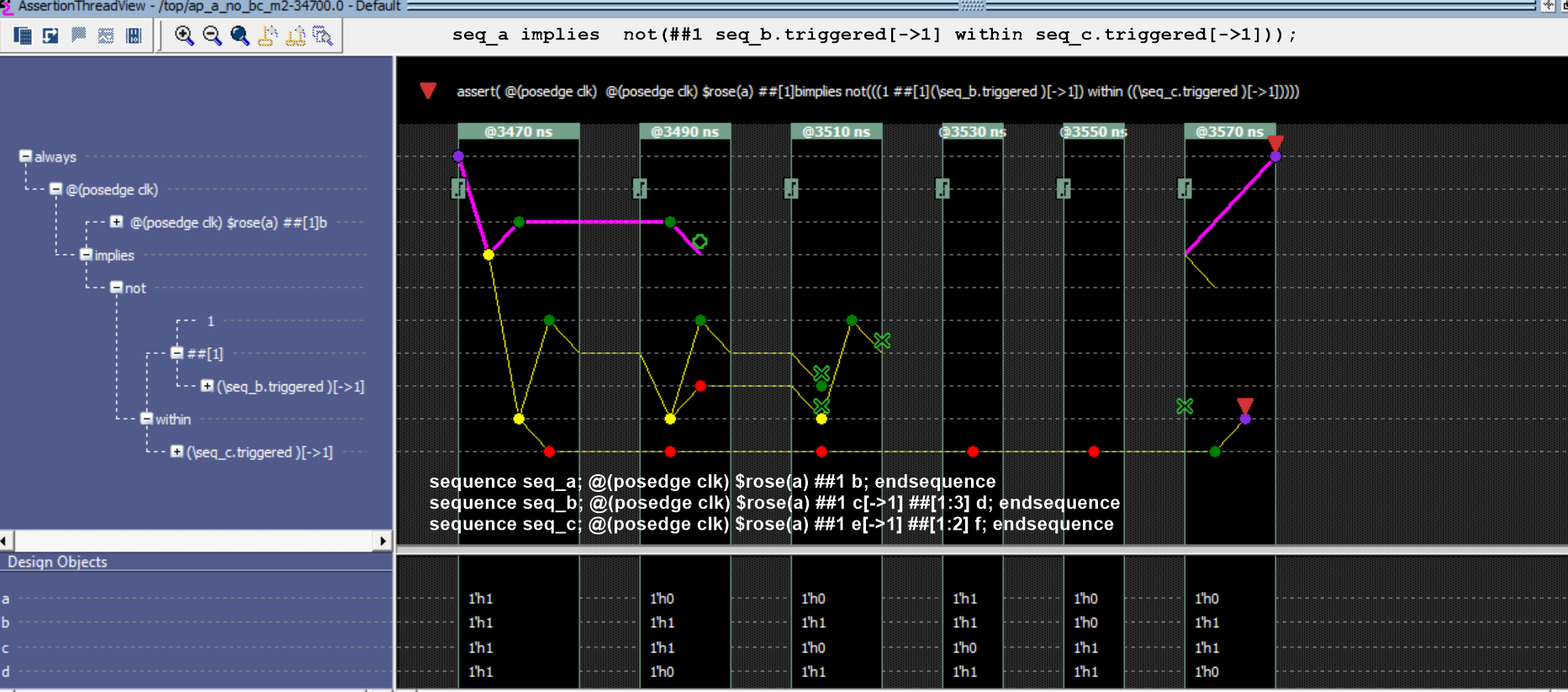
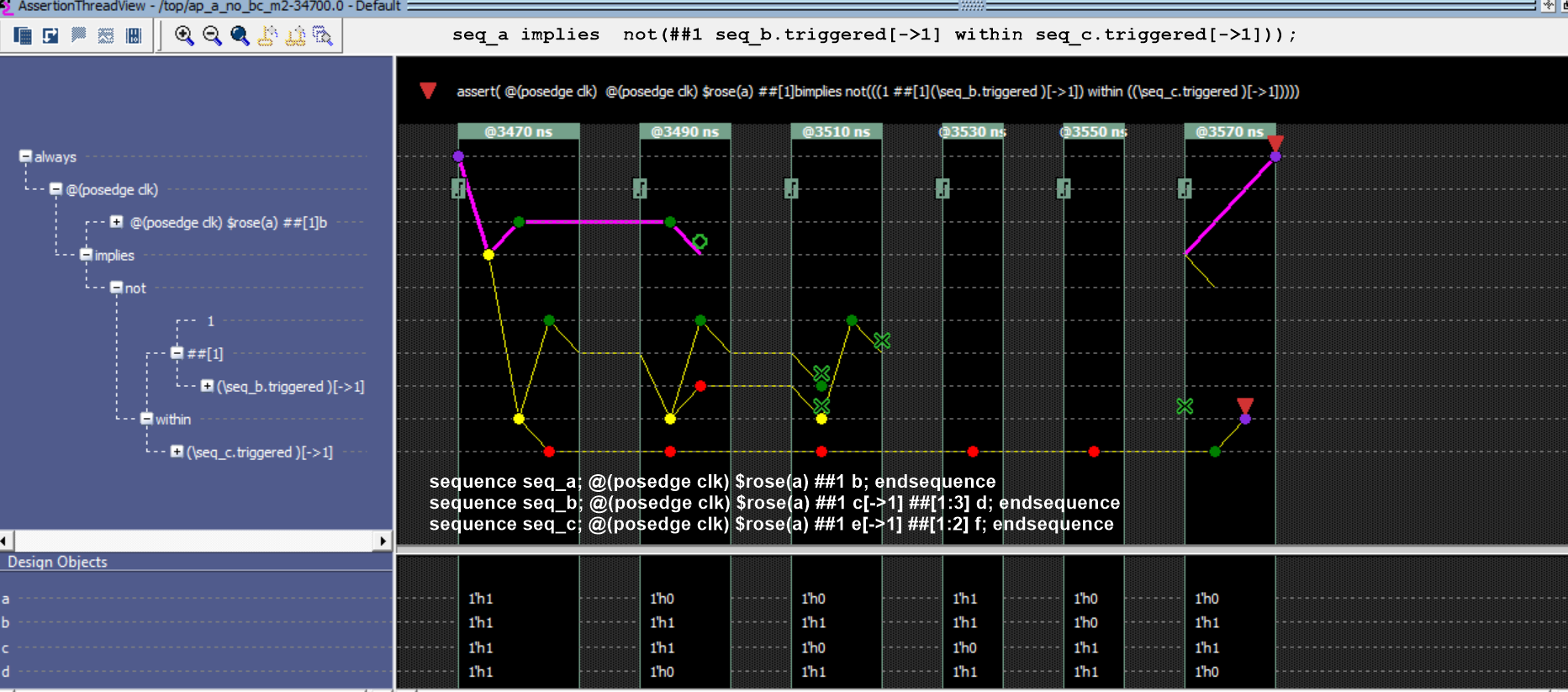
Thread viewer http://systemverilog.us/vf/Seqm2.png
module top;
    timeunit 1ns;  timeprecision 100ps;
    `include "uvm_macros.svh"   import uvm_pkg::*;
    bit clk, a, b, c, d, e, f, reset_n;
    initial forever #10 clk = !clk;

    // once seq_a is triggered, before seq_c triggered, seq_b should not happen.
    // suppose seq_a, seq_b, and seq_c are all defined already.
    sequence seq_a; @(posedge clk) $rose(a) ##1 b; endsequence
    sequence seq_b; @(posedge clk) $rose(a) ##1 c[->1] ##[1:3] d; endsequence
    sequence seq_c; @(posedge clk) $rose(a) ##1 e[->1] ##[1:2] f; endsequence
    // NOTE: The $rose(a) ##1 var[->1] is needed to avoid uneeded endpoints
    //       that are used in the assertions.
    // INTERPRETATION 1 OF REQUIREMENTS
    // If seq_a starts and completes, then
    //    * that same start time (e.g., the $rose(a))
    //      the completion seq_b (i.e., its endpoint) followed by seq_c should not occur
    /* seq_a                    |======>
       seq_b                       <=====> // ERROR: seq_b before seq_c
       seq_b.triggered      ^   |........^
       seq_c                              <======>    */
    ap_a_no_bc_m: assert property(@(posedge clk)
    seq_a implies  not(##1 seq_b.triggered[->1] ##1 seq_c));

    // INTERPRETATION 2 OF REQUIREMENTS
    // If seq_a starts and completes, then
    //    * that same start time (e.g., the $rose(a))
    //      the completion seq_b (i.e., its endpoint)
    //           should not be inside the completon of seq_c
    //      Note: seq_b and seq_c can start at any time
    /* seq_a                    |======>
       seq_b                       <=====> // ERROR: seq_b before seq_c
       seq_b.triggered      ^   |........^
       seq_c                          <======>
       seq_c.triggered          |............^            */
    ap_a_no_bc_m2: assert property(@(posedge clk)
         seq_a implies  not(##1 seq_b.triggered[->1] within seq_c.triggered[->1]));

    // After seq_a then seq_b should be followed by seq_c
    ap_a_no_bc: assert property(@(posedge clk)
       seq_a |->  not(seq_b ##0 seq_c));

    initial begin
      repeat (200) begin
        @(posedge clk);
        if (!randomize(a, b, c, d, e, f)with {
            a  dist {1'b1 := 1, 1'b0 := 3};}) `uvm_error("MYERR", "This is a randomize error");
      end
      $finish;
    end
  endmodule
Ben Cohen
http://www.systemverilog.us/ ben@systemverilog.us
** SVA Handbook 4th Edition, 2016 ISBN 978-1518681448
…
Udemy courses by Srinivasan Venkataramanan (http://cvcblr.com/home.html)
https://www.udemy.com/course/sva-basic/
https://www.udemy.com/course/sv-pre-uvm/
In reply to Jeff_Li_90:
You’re welcome :)
BTW, the following suggestion was made to me.
 ap_new: assert property(@ (posedge clk)
       seq_a |-> (!seq_b.triggered throughout seq_c.triggered[->1]));
Possible issue: seq_a attempt at **rose(a)**can occur in the same cycle as seq_b.triggered. A requirement?
Use of the implies: My colleague is always searching for efficiency. In his opinion,
he prefers to stay away from using implies because it is more expensive than using |-> or |=> or just negation. Thus, instead of:
seq_a implies  not(##1 seq_b.triggered[->1] within seq_c.triggered[->1]));
// USE
not( (seq_a and ##1 seq_b.triggered[->1] ) within seq_c.triggered[->1]));
Anyway, some tidbits to consider.
Ben SystemVerilog.us