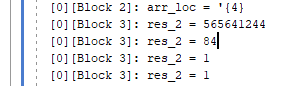
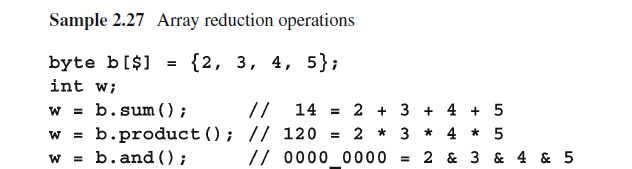
Here’s my full code.
I had have commented the queue reduction at lines 14 and 16.
Also the print issue I mentioned regarding the sum operation is at line
1. module tb_array_methods;
2.     function void disp_msg(input string tag, input string msg);
3.         $display($sformatf("[%0t][%0s]: %0s", $time, tag, msg));
4.     endfunction
5.     int arr[$] = {21,33,42,20,20,42,11,24,33};
6.     longint res;
7.     int arr_loc[$];
8.     int res_2;

9.     bit b_array[] = '{1,0,0,1,0,1};

10.     ///// Array Reduction Methods
11.     initial begin
12.         res = arr.sum();
13.         disp_msg("Block 1", $sformatf("res_sum = %0d", res));
14.         // res = arr.product();
15.         // disp_msg("Block 1", $sformatf("res_product = %0d", res));
16.         // res = arr.and();
17.         // disp_msg("Block 1", $sformatf("res_and = %0d", res));
18.     end

19.     // ====================================== //
20.     // Array Locator Methods
21.     // All array locator methods return the results as a queue of type "int" and not "integer"
22.     initial begin
23.         arr_loc = arr.min(); // Returns {11}
24.         disp_msg("Block 2", $sformatf("arr_loc = %0p", arr_loc));
25.         arr_loc = arr.max(); // Returns {42}
26.         disp_msg("Block 2", $sformatf("arr_loc = %0p", arr_loc));
27.         // Min and Max function also work for associative arrays

28.         arr_loc = arr.unique();
29.         disp_msg("Block 2", $sformatf("arr_loc = %0p", arr_loc));

30.         // We require an queue variable to store these results. Why?
31.         // Because in case of empty queues, the functions will return empty queue.

32.         //////////////////////////
33.         // "with" operator
34.         arr_loc = arr.find() with (item > 34); // Returns a queue of type int
35.         disp_msg("Block 2", $sformatf("arr_loc = %0p", arr_loc));

36.         arr_loc = arr.find(x) with (x <42);
37.         disp_msg("Block 2", $sformatf("arr_loc = %0p", arr_loc));

38.         arr_loc = arr.find_index() with (item == 33);
39.         disp_msg("Block 2", $sformatf("arr_loc = %0p", arr_loc));

40.         arr_loc = arr.find_first_index() with (item == 32); // Returns an empty string
41.         disp_msg("Block 2", $sformatf("arr_loc = %0p", arr_loc));

42.         arr_loc = arr.find_last_index with (item == 20);
43.         disp_msg("Block 2", $sformatf("arr_loc = %0p", arr_loc));


44.         // How about we combine some boolean functions with locators?
45.         //int arr[$] = {21,33,42,20,20,42,11,24,33};
46.         res_2 = arr.sum() with (item>34);
47.         // Returns sum({0,0,1,0,0,1,0,0,0}) = 2;
48.         // This can be used to find the count of certain values
49.         disp_msg("Block 3", $sformatf("res_2 = %0d", res_2));

50.         res_2 = arr.sum() with (item * (item>34));
51.         // Returns sum({0,0,42,0,0,42,0,0,0}) = 84;

52.         res_2 = arr.sum() with (item > 34? item:0);
53.         // Returns 84
54.         disp_msg("Block 3", $sformatf("res_2 = %0d", res_2));
55.

56.         // One has to be careful of bit widths!
57.         // sum() function uses the width of the array's data
58.         // So if we add values of a 1-bit array, using sum(), we will will get a single bit result of either 0 or 1
59.         // So we need to type cast values before.

60.         res_2 = b_array.sum(); // Total = (1 + 1 + 1) = 1 (in 1-bit addition)
61.         disp_msg("Block 3", $sformatf("res_2 = %0d", res_2));

62.         res_2 = b_array.sum() with (int'(item)); // Total = 1 + 1 + 1 = 3
63.         disp_msg("Block 3", $sformatf("res_2 = %0d", res_2));
64.     end

65.     //===================================//
66.     // Array Sorting and Ordering
67.     // Unlike array locators and reduction operators, these change the original array!!
68.     int d [] = '{2,1,2,42,3,5};

69.     struct packed {bit [7:0] r,g,b;} pix[];
70.
71.     initial begin
72.         #40;
73.         pix = '{'{r:7, g:34, b: 65}, '{r:70, g:49, b: 6},'{r:46, g:32, b: 63}};
74.         //Structures also use '{} instead of {} for full structure assignment
75.         d.reverse();
76.         disp_msg("Block 4", $sformatf("Reverse = %0p", d));

77.         d.sort();
78.         disp_msg("Block 4", $sformatf("Sorted = %0p", d));

79.         d.shuffle();
80.         disp_msg("Block 4", $sformatf("Shuffled = %0p", d));

81.         d.rsort();
82.         disp_msg("Block 4", $sformatf("Reverse Sorted = %0p", d));

83.         // reverse() and shuffle() don't have a "with" clause. But others have...
84.         pix.sort() with (item.r); // Sort using r only
85.         disp_msg("Block 5", $sformatf("Structure with sorting based on Red= %0p", pix));
86.         // pix = '{'{r:7, g:34, b: 65}, '{r:46, g:32, b: 63}, '{r:70, g:49, b: 6}};

87.         pix.sort() with ({item.g, item.b}); // Sort first based on g then b
88.         disp_msg("Block 5", $sformatf("Structure with sorting based on Red= %0p", pix));
89.         // pix = '{'{r:70, g:49, b: 6}, '{r:46, g:32, b: 63},'{r:7, g:34, b: 65}};

90.         // Only fixed & dynamic arrays and queues can be sorted, reversed or shuffled
91.         // Associative arrays cannot be re-ordered because it's a key based storage.
92.         // We can't just say move this key before that key.

93.
94.     end
95. endmodule