In reply to Verif Engg:
I have a synchronous FIFO. The depth of the FIFO is 32. Every time the FIFO has 7 or any “n” unique elements inside it, “unique” signal goes HIGH. How do I test the “unique” signal going high in SystemVerilog or UVM? How would my scoreboard look like?
Appreciate any thoughts/ideas.
- I am a bit puzzled by the hardware algorithm you used to test the number of unique entries.
- For a testbench, you have the luxury of using associative arrays with interesting methods such as “exists” “num” and “size”
- In the model below, I did use the exists and num.
- I tailored the stimulus vectors to avoid pops on empty queue.
The model(with some lines from 1800’2012 on associative array and queues is at
http://systemverilog.us/vf/unique_entry.sv
// Also see my reply (below) as this model is not complete.
import uvm_pkg::*; `include "uvm_macros.svh"
module top;
	bit clk, pop, push;
	int data=8;
	int aa[int]; // associative array
	int q1[$];  // queue, emulating the fifo
	int num_unique=0;
	always @(posedge clk)  begin
		automatic int temp_pop;
		if(push && !pop)
			if(!aa.exists(data)) begin // is unique
				aa[data]=1;  // flag data into associative array
				num_unique <=  num_unique+1'b1; // incremnet number of uniques
				q1.push_front(data); // maintain the queue
			end
		if(pop && !push && q1.size != 0) begin
			temp_pop=q1.pop_back(); // maintain the queue
			num_unique <= num_unique - 1'b1; // decrement uniques
			aa.delete(temp_pop); // delete the associative array entry
		end
		a_unique: assert(aa.num <= 7);
	end

	initial forever #10 clk=!clk;

	initial begin
		repeat(5) push <= 1'b1;
		repeat(200) begin
			@(posedge clk);   #2;
			if (!randomize(push, pop, data)  with
					{ push dist {1'b1:=1, 1'b0:=2};
					  pop  dist {1'b1:=1, 1'b0:=8};
					  data dist {[1:99]:=1, [0:0]:=3};
					}) `uvm_error("MYERR", "This is a randomize error")
		end
		$stop;
	end
endmodule
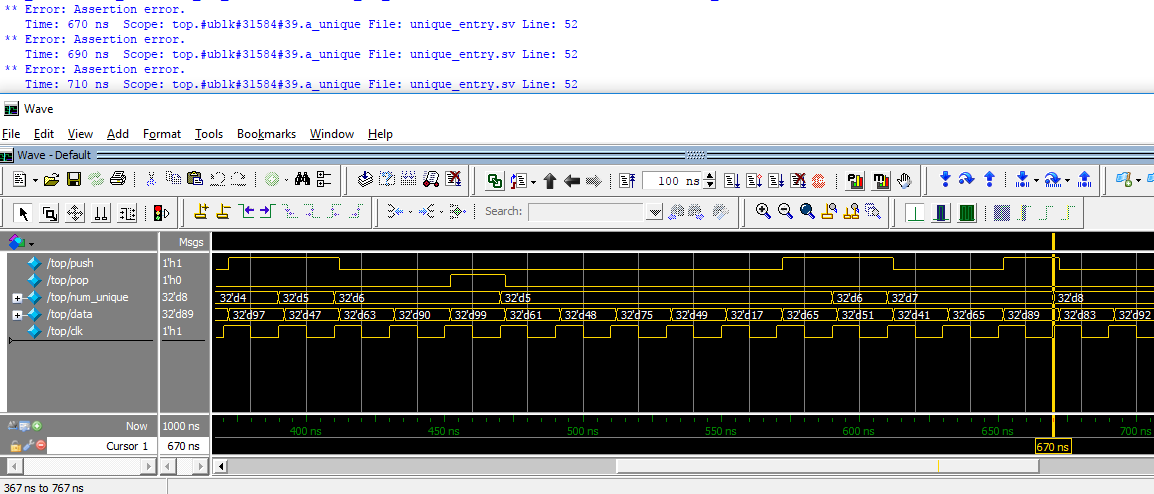
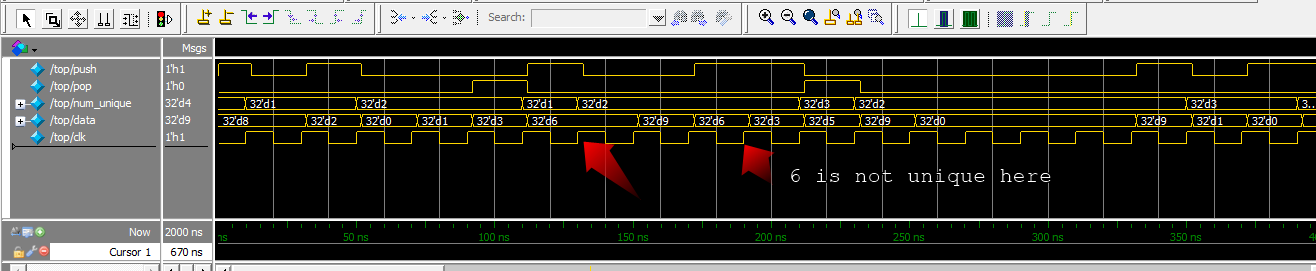
Modifying the data stream with the following constraint
data dist {[1:9]:=1, [0:0]:=3};
causes less unique possibilities.
Ben Cohen
http://www.systemverilog.us/ ben@systemverilog.us
For training, consulting, services: contact Home - My cvcblr
- SVA Handbook 4th Edition, 2016 ISBN 978-1518681448
- A Pragmatic Approach to VMM Adoption 2006 ISBN 0-9705394-9-5
- Using PSL/SUGAR for Formal and Dynamic Verification 2nd Edition, 2004, ISBN 0-9705394-6-0
- Real Chip Design and Verification Using Verilog and VHDL, 2002 isbn 978-1539769712
- Component Design by Example ", 2001 ISBN 0-9705394-0-1
- VHDL Coding Styles and Methodologies, 2nd Edition, 1999 ISBN 0-7923-8474-1
- VHDL Answers to Frequently Asked Questions, 2nd Edition ISBN 0-7923-8115