Hi Forum,
I have a few questions on configuring agent component to active / passive mode
(1) UVM LRM says
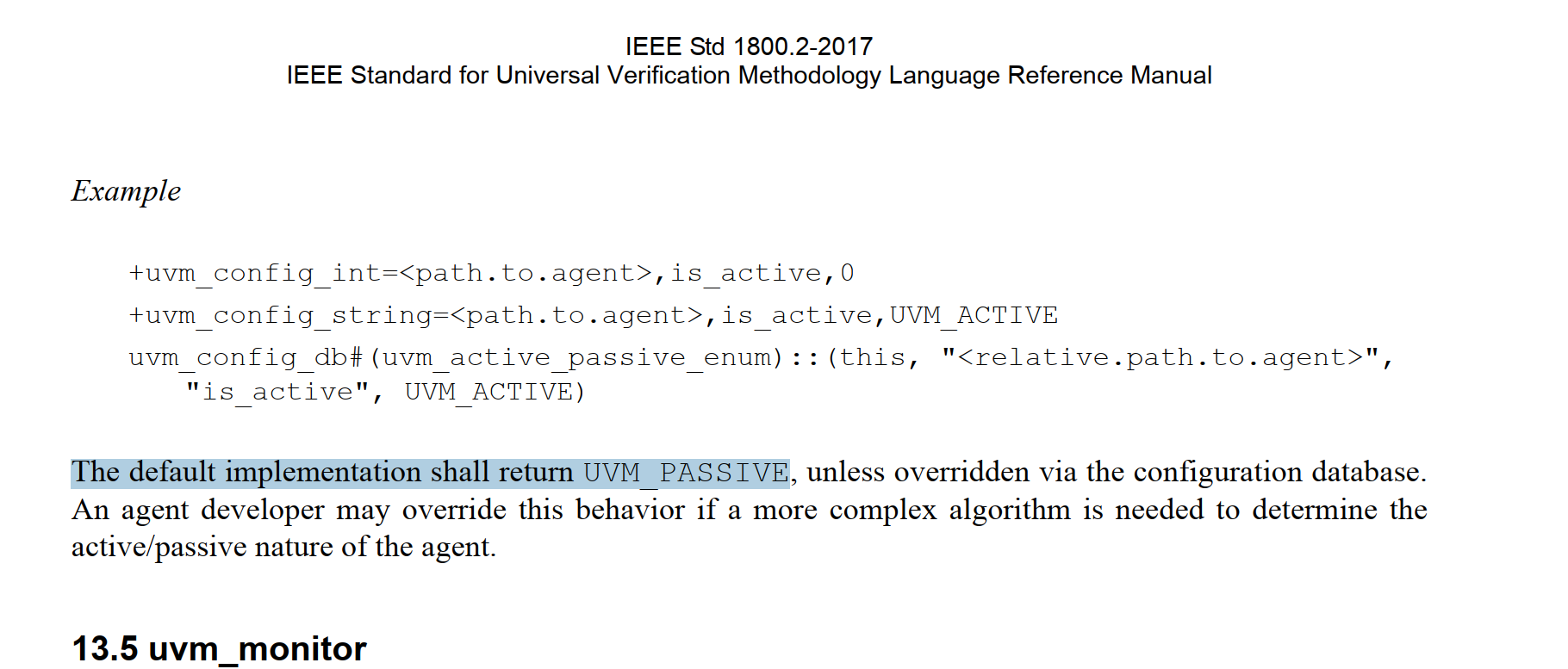
“The default implementation shall return UVM_PASSIVE, unless overridden via the configuration database.“
I went through the source code for UVM where within the virtual class uvm_agent
I observe uvm_active_passive_enum is_active = UVM_ACTIVE;
Hence by default every agent is in active mode
(Q1) Doesn’t this conflict with the above LRM quote ?
(2) I observe that build_phase() of the virtual class uvm_agent has a logic to retrieve configuration for the enum variable is_active ( Refer source_code )
Assume that there are multiple set from same level of hierarchy during build_phase() ,
(Q2) Wouldn’t the multiple if conditions within the for loop result in an implicit precedence ?
The 1st if condition looks for setting via type uvm_active_passive_enum followed by type uvm_integral_t , followed by uvm_bitstream_t, followed by int,followed by int unsigned and then finally of type string
Assume there are 6 calls to set from same level of hierarchy (one of each of the 6 types above)
(Q3) Would the set via type uvm_active_passive_enum take effect over the other 5 types ?
(Q4) From a simulation performance perspective, wouldn’t it be better not to call super.build_phase(phase) from user’s agent class ? There could be multiple agent’s in a Tb and each agent would iterate through the logic
User should have their own logic to fetch any configuration object for is_active
This would ensure that the set needs to be a certain type to take effect
Thanks